
What happens when 2 BigLaw attorneys take their 25,000+ billable hours, reverse engineer them into exactly what a junior M&A lawyer needs to know, and build them into a platform that teaches it all upfront?
Meet rubi, the first virtual apprenticeship in transactional law.
Now fully integrated with the new rubi AI Mentor | Now fully integrated with the new rubi AI Mentor
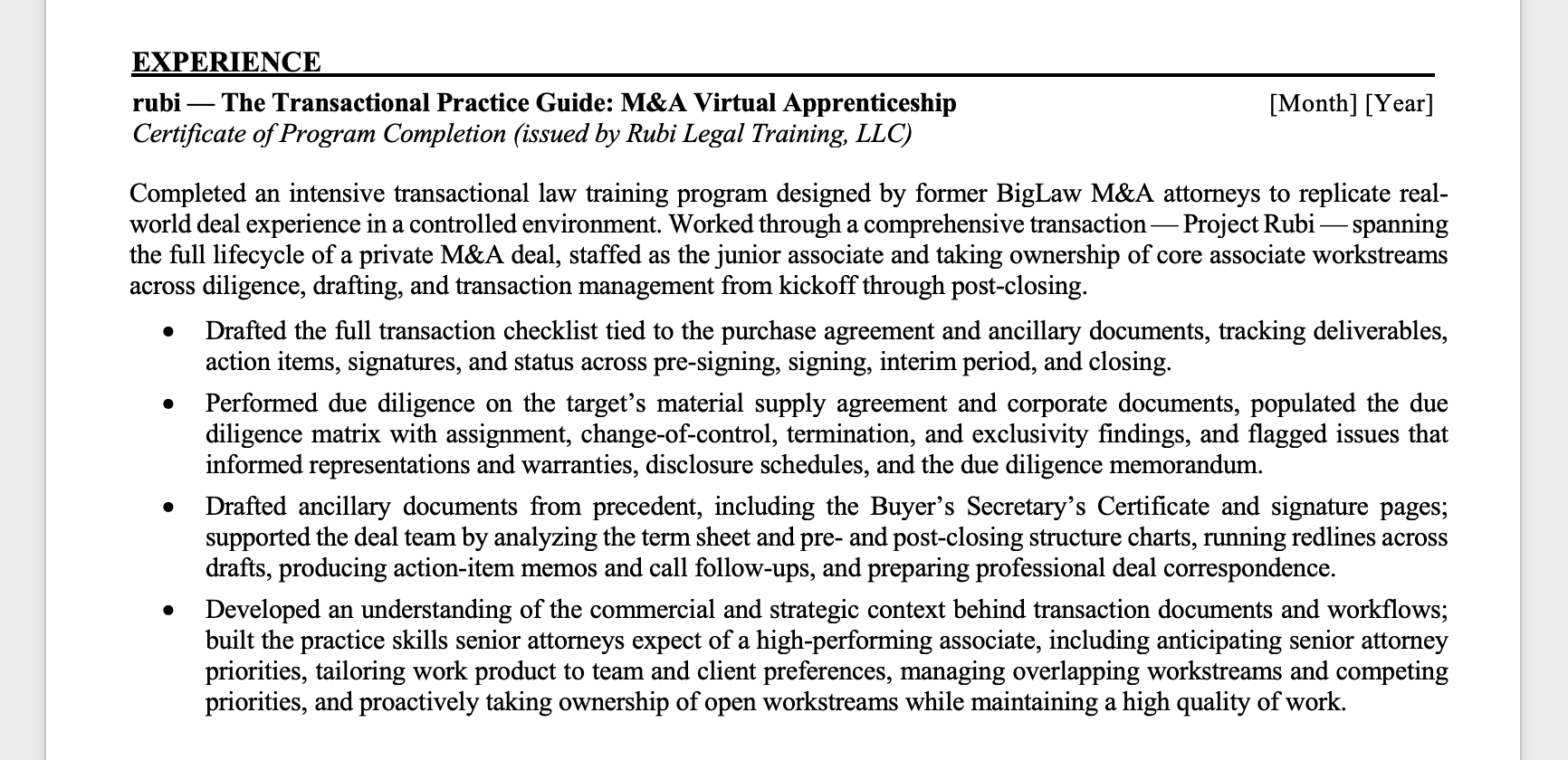
The resume of the lawyer you came here to be
You have the ambition. rubi gives you the apprenticeship. Your resume writes itself.
Congrats on the new deal — and the fact that you're thinking about this before you even open your inbox tells me you're going to make a great first impression. Since you've been through the whole program, you've actually got everything you need here — this is just about pulling the right pieces together.
Respond promptly and get your bearings. Reply to whoever staffed you quickly, even if it's just confirming you're available. Then find out where the deal stands — is there a term sheet, a structure chart, a working group list? Those are the fastest way to get situated: who the parties are, the deal structure, and who's who on both sides.
Save everything to a deal folder and start your cheat sheet. Key facts — parties, purchase price, structure, matter number, deal team — go on a running list from day one. You won't remember it all later, and you don't want to be the one who can't answer a basic question about your own deal.
Learn this new team's preferences early. Since you haven't worked with them before, pay attention to how they like to communicate, how they want comments incorporated, and how they expect you to submit work. If you're not sure, just ask — or ask someone who's worked with them before what they should know.
Since it's buy-side, get ready for diligence to kick off soon. That's usually one of the first major workstreams on a buy-side deal, so expect a data room, a diligence request list, or a kickoff email to land before too long. Get familiar with the data room structure and confirm your scope of review before you dive in.
Take detailed notes on everything, from day one. Any call, any email with background — assume you'll need it later, even if you don't understand the significance yet.
You've built the exact playbook for this already — trust it, and lean into asking good questions with this new team as you go.
From the rubi program
Happy to walk through this — it's a small thing that has an outsized effect on how much your team trusts you early on.
Assume you're providing notes for the team, even if no one asked outright. Whoever's leading the call usually can't take detailed notes themselves while running it, so your notes may be the only real record of what happened.
Transcribe rather than summarize. Write down as close to word-for-word as you can, rather than filtering things through your own understanding of what's "important." You have limited context right now, so you're not in a great position to judge what to leave out — and you're billing the same time either way, so more detail costs you nothing.
Follow the agenda or document being discussed, in order. If the call is walking through a document, note the section references (e.g., "Section 3.4a of the MIPA") so whoever reads your notes can go straight to the right spot without having to reconstruct context.
Track who said what. Pull up the working group list or calendar invite beforehand so you know the attendees, and note which side is speaking, even if you can't always catch individual names in the moment.
Flag anything you don't understand instead of dropping it. If you hear an unfamiliar term or acronym, write it down anyway — misspelled if you have to — with a question mark. Leaving it out entirely is worse than flagging it.
Make action items easy to find. Bold or highlight them, or pull them into a short summary at the top, so whoever reads your notes doesn't have to dig for what actually needs to happen next.
From the rubi program
Congrats—on a new buy-side deal, the fastest way to become useful is to get the deal architecture into your head before diving into execution.
1. Get oriented first
Spend 30–60 minutes figuring out:
- Who is the buyer, target, and key shareholders?
- What is the transaction thesis? Why is the buyer doing this deal?
- Where are we in the process: early diligence, IOI/LOI, exclusivity, confirmatory diligence, signing, etc.?
- What is the expected timeline and next major milestone?
- Who are the other advisors: lawyers, accounting/QoE, tax, commercial diligence, financing, consultants?
- What are the key workstreams and who owns each one?
- What does the senior team already know, and what are the open questions?
Ask for the latest CIM, management presentation, teaser/IOI/LOI if available, process letter, and any existing workplan or diligence tracker.
2. Understand exactly what your team needs from you
Because you haven't worked with this team before, don't assume their preferred workflow. Ask your immediate senior:
"What are the top 2–3 things you'd like me to own, and what does good look like on each?"
Then clarify:
- Deliverable and deadline
- Source of truth for data
- Preferred Excel/model conventions
- Whether they want you to own a workstream or just support it
- Who reviews your work before it goes upward
- Any precedent materials from prior deals you should use
This is especially important on buy-side deals because there can be a lot of parallel diligence and relatively little time.
3. Build your own deal map
I would create a simple personal page with:
| Area | What to capture |
|---|---|
| Transaction | Buyer, target, structure, valuation, financing |
| Process | Current stage, key dates, next milestone |
| Thesis | 3–5 reasons buyer wants the asset |
| Key risks | Biggest diligence/valuation concerns |
| Financials | Revenue, EBITDA, growth, margins, leverage |
| Synergies | Amount, type, timing, confidence |
| Diligence | Commercial, financial, tax, legal, HR, IT, etc. |
| Workstreams | Owner + status + next action |
| Open questions | Questions that still need answers |
The point isn't to make something pretty. It's to give yourself a mental model of the transaction.
4. Read the numbers with an M&A lens
Don't just memorize the financials. Understand:
- Revenue and EBITDA growth
- Organic vs. acquired growth
- Margin trajectory
- Customer concentration
- Recurring vs. non-recurring revenue
- Working-capital dynamics
- Capex requirements
- Debt / cash
- Management's forecast vs. historical performance
- Purchase price and valuation
- Sources & uses
- Synergies and their timing
- What assumptions actually drive returns
Then ask yourself:
"What would have to be true for the buyer to make an attractive return?"
That's usually much more valuable than simply knowing the model.
5. Learn the team's working style quickly
On your first few days, pay attention to things that aren't written anywhere:
- Who actually makes decisions?
- Does the VP want polished work or rough work quickly?
- Does the associate prefer Slack/Teams, email, or verbal updates?
- How much checking is expected before sending something?
- What formatting conventions do they use?
- What does the MD care about?
- What does the team routinely forget or scramble for?
A good rule: communicate earlier than you think you need to. If you hit a blocker, don't disappear for three hours trying to solve it silently.
6. Find a way to create value immediately
Don't wait for someone to hand you a giant assignment. Good early contributions include:
- Cleaning/updating the diligence tracker
- Building a key financial/operating KPI analysis
- Reviewing the CIM for inconsistencies or unanswered questions
- Comparing management's forecast to historical performance
- Building a list of diligence questions
- Taking ownership of one diligence workstream
- Maintaining the issues/action-items log
- Turning messy data into something the senior team can actually use
The ideal outcome after your first week is that someone can say:
"I don't need to worry about X anymore—[you] own it."
7. Your first 48 hours
I'd prioritize it roughly like this:
- Get the deal materials.
- Read the CIM / core materials once without building anything.
- Meet with your immediate senior and understand your responsibilities.
- Review the model and understand the major drivers.
- Map the diligence/workstreams and key dates.
- Identify 5–10 things you don't understand.
- Ask targeted questions rather than broad "can you explain the deal?" questions.
- Take ownership of one concrete piece of work.
- Send concise progress updates before people have to chase you.
One thing I'd particularly avoid: trying to demonstrate value by immediately producing a ton of analysis before understanding what the team actually cares about. On a new deal team, being highly responsive, organized, accurate, and easy to work with is often more valuable initially than producing something sophisticated that nobody asked for.
Absolutely. For an M&A kickoff, don't try to create a transcript. Your job is to capture what matters, what was decided, what needs to happen, and who owns it.
Before the call
- Open a fresh document with the deal name, date, attendees, and purpose of the call.
- Have the deal team / workstream list handy so you can map comments to owners.
- Pull up any existing agenda or workplan.
- Set up sections for: key takeaways, decisions, workstreams / updates, open questions, action items, key dates / milestones
During the call
Use a simple rule:
Don't write down everything someone says. Write down what changes your understanding of the deal or what someone will need to act on.
Pay particular attention to:
- Decisions: "We agreed to…"
- Action items: "X will do Y by Friday."
- Open questions: "We still need to determine…"
- Risks/issues: "The concern is…"
- Numbers: valuation, timing, thresholds, forecasts, synergy targets, etc.
- Management comments: anything that changes the team's view of the business.
- Partner/MD direction: these are particularly important.
- Dependencies: "We can't finalize X until Y comes back."
- Deadlines: especially anything not already on the formal timeline.
A useful shorthand is:
ACTION — Who / What / When
DECISION — What was agreed
QUESTION — What needs to be answered
RISK — What's potentially problematic
Don't worry about making sentences perfect while the call is happening. Capture the substance quickly.
Immediately after
Spend 10–15 minutes cleaning the notes while the discussion is fresh. Turn rough notes like:
tax — need check NOLs? maybe Deloitte — buyer wants before next week
into:
Tax: Confirm availability and utilization of NOLs. Deloitte to provide analysis before next week's diligence meeting.
Then pull every action item into one clean list:
| Owner | Action | Due |
|---|---|---|
| Deloitte | Confirm NOL availability/utilization | Before next diligence meeting |
| Legal | Circulate revised diligence request list | TBD |
| Buyer team | Review management responses | Friday |
What the partner probably wants
The best notes are short enough that a senior person can scan them in 2 minutes and immediately know: what happened, what we learned, what we decided, what's outstanding, who is doing what, and what happens next.
Don't send a 10-page transcript. A 1–3 page executive-style summary plus a crisp action-item list is usually much more useful.
One final trick: when the partner says something like "Let's make sure we…", "We need to…", or "Can someone…", your ears should immediately perk up. Those phrases very often contain the most important action items.
That changes the emphasis a bit. As a junior lawyer on a buy-side M&A kickoff, your notes should be more legally oriented than banker-style notes, while still being concise enough for the partner to use.
What to listen for
Organize your notes around these buckets:
Transaction / structure
- Buyer, target, acquisition structure
- Stock vs. asset deal
- Consideration / rollover / earnout
- Financing or other structural conditions
- Signing vs. closing expectations
Process / timing
- LOI / exclusivity status
- Target signing and closing dates
- Diligence deadlines
- Drafting / markup deadlines
- Financing or regulatory milestones
Legal workstreams
- Corporate / organizational
- Commercial contracts
- Employment / benefits
- IP / technology
- Regulatory
- Litigation
- Real estate
- Tax
- Antitrust / CFIUS or other foreign investment issues, if relevant
Issues / red flags
- Anything someone identifies as a concern
- Exceptions to the standard approach
- Known disputes or unusual contractual provisions
- Consent requirements
- Change-of-control provisions
- Regulatory approvals
- Anything that could affect signing, closing, price, or deal structure
Client / business priorities
- What matters most to the buyer
- Issues they're willing to accept
- Issues they consider deal-breakers
- Commercial points that should drive the legal analysis
Assignments
- Who owns each diligence area
- What needs to be reviewed
- Who is responsible for contacting whom
- Deliverable and deadline
The most important distinction
Don't try to capture every legal statement. Capture the conclusion and its consequence.
For example, instead of:
"The target has several customer agreements that contain provisions relating to assignment, and someone mentioned that some may require consent…"
write:
Commercial contracts: Several material customer agreements may require consent upon a change of control. Team to identify affected agreements and assess whether consents are required before signing/closing.
That gives the partner something actionable.
Be particularly careful with legal conclusions
If you're not sure whether something was actually decided, don't turn a tentative comment into a definitive conclusion. Distinguish:
- "Counsel confirmed…" → definitive
- "Team believes…" → current view
- "Question raised regarding…" → unresolved
- "Need to confirm…" → action item
This matters a lot when your notes get circulated and people later rely on them.
A good structure for your notes
- 1. Key takeaways — Five or fewer bullets covering the most important things discussed.
- 2. Transaction / process — Key structural points and timeline.
- 3. Legal workstreams — Brief notes under each relevant diligence/workstream area.
- 4. Key issues / open questions — Anything requiring further investigation or partner/client attention.
- 5. Action items — Owner | Action | Deadline. This last section is arguably the most important part of your notes.
One junior-lawyer habit that will make you look good
During the call, put a "?" next to anything you're not sure you understood rather than stopping the conversation to clarify every point. Immediately afterward, resolve those questions by checking the deal materials or asking the associate. Then make sure the final notes distinguish facts, decisions, and open issues.
And if the partner specifically said "take notes," I'd generally not try to turn them into formal minutes unless asked. Think of them as a clean internal record that helps the deal team execute.
rubi is for
law firms|junior associates|in-house counsel|laterals|summer associates|law students|aspiring attorneys
Get a free preview & experience rubi yourself
We've received your request.
Look out for an email from the rubi team.
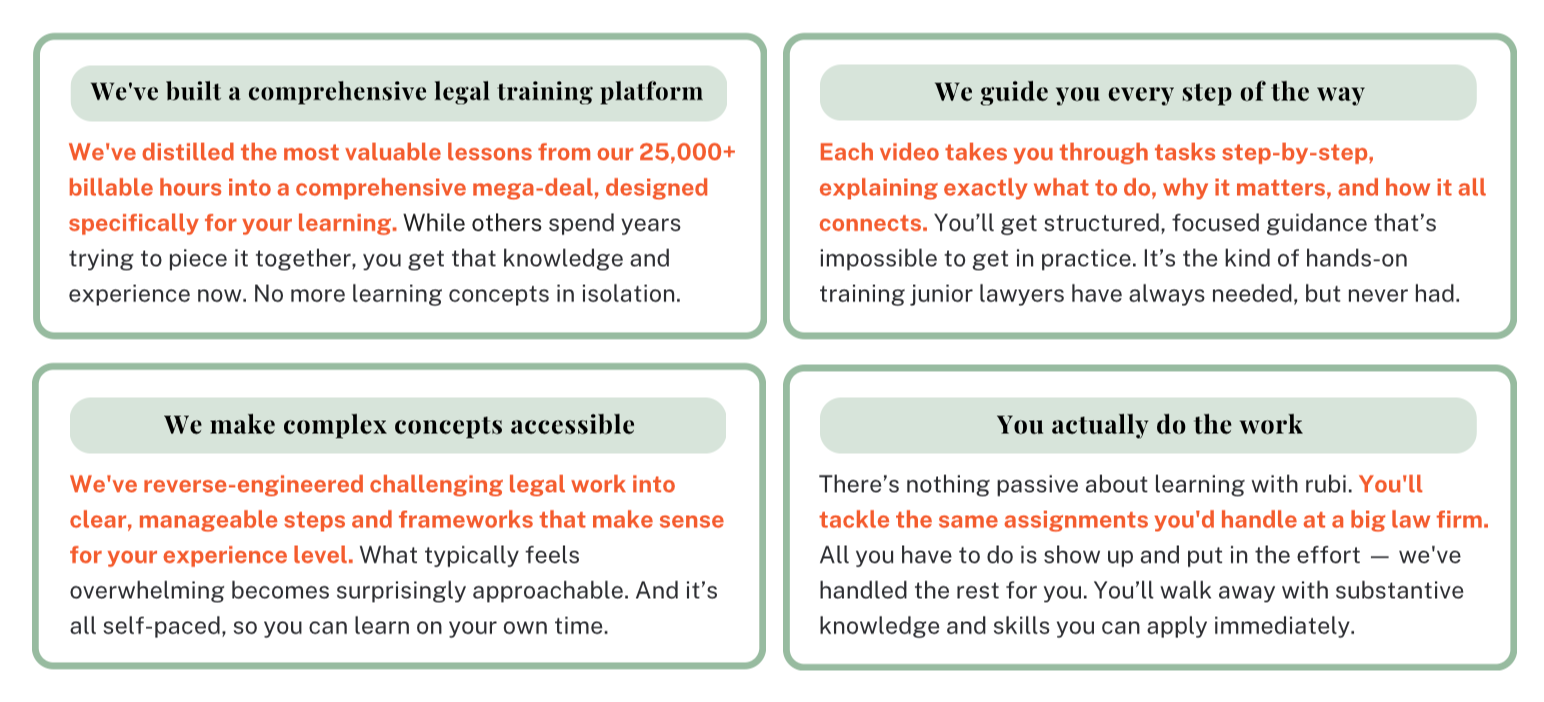
How rubi works
Hear what rubi associates are saying
Testimonials from law students to attorneys with a decade of experience
“rubi offers insight that typically only comes with years of experience and helps connect nuances of transactional practice that can be difficult to piece together early on. Madison and Geetika walk you through what you need to know, delivering concepts in a clear, digestible manner, and drawing on their own experiences and understanding of the first-year learning curve.”
“The rubi program has been instrumental in helping me get better at understanding the purchase agreement, internalizing expectations of junior associates at each step of the process, and developing a heuristic for responsiveness, ownership, and detail-orientedness in a way that has greatly benefited me even outside the direct M&A context! This program is a must-have if you're trying to thrive as an associate in a transactional biglaw setting and is one I wish I had access to earlier!”
“rubi will help to de-mystify what is expected of a transactional attorney in a Big Law firm. Understanding Big Law culture - how juniors, mid-levels, seniors, and partners work together, what excellent work product looks like, and how the work day is structured - can really help to reduce the culture shock many associates face. rubi will benefit summer associates, junior associates, laterals, associates changing practice areas, and law students.”
“I think this would have been great my first week at my summer associate position. Navigating the biglaw environment and figuring things out on the fly was frustrating and I always felt like I was bothering people with questions. The info is spot on . . . [it] was very informative and delivered well. I like the brevity. It is very straight forward and I couldn't really pick out anything that was superfluous.”
“It is nice that both speakers are clearly very experienced in the world of big law, so explanations feel very well informed, but they're still also very personable so it doesn't feel like just another cold training video. It could be a fantastic tool for established attorneys interested in switching practices. You not only learn about what it means to be a transactional attorney, but can gain some experience as one.”
“rubi is a crash course for the transactional law profession that provides you with the firm foundation you need to succeed in your future career before you even step through the doors. Through a series of videos with sample assignments that work through a full sample deal, rubi teaches you the background and skills you need to excel. I have a lot of faith in these instructors and I would be eager to learn from any more content that they put out on any platform.”
- Lily M. (Law Student at The University of Texas School of Law)
“I think a training program like rubi should be required for all lawyers alongside on the job training. Before rubi, I didn't receive any formal training outside of being assigned tasks. There was very minimal background information or training that dives into the subject matter of the work. . . . This is the first program like this that I've heard of.”
Meet the founders
After years of developing rubi, we're excited to finally share it with you.
-Madison & Geetika, Co-Founders & Co-CEOs
Madison Keeble
Corporate / M&A Lawyer since 2017, including 7 years in BigLaw at a leading global firm. Advanced from Summer Associate to Senior Associate, managing transactions & leading cross-functional teams.
Highlights & Credentials
Awarded Best Lawyers: Ones to Watch in America (M&A Law, Corporate Law, and Energy Law)
Graduated top 1% of law school class
(#2 of 296); Summa Cum Laude
Inducted into the Order of the Coif national honor society
Awarded Dean's List every semester in law school
Contributed to strategic innovation and legal tech initiatives as representative of firm's tech committee
Earned a 100/100 evaluation score upon promotion to senior associate
Served on SMU Law Review Association as Associate Editor & Articles Editor
Selected as a Teaching Assistant for Legal Research, Writing, and Advocacy as a 2L and 3L
Assisted in research, writing, and production of practitioner's guide on Texas trade secrets law
Served as a judicial intern for The Honorable Barbara M. G. Lynn, United States District Court for the Northern District of Texas
SMU Women in Law Member
Education
Southern Methodist University, SMU Dedman School of Law, J.D., Summa Cum Laude (2017)
The University of Texas at Austin, McCombs School of Business, B.B.A. Finance (2013)
Geetika Jerath
Corporate / M&A Lawyer since 2019, including 5 years in BigLaw at a leading global firm. Progressed from Summer Associate to Associate, functioning as the deal lead on transactions.
Highlights & Credentials
Awarded Best Lawyers: Ones to Watch in America (M&A Law and Project Finance Law)
Assisted with argument preparation for U.S. Supreme Court case, Fisher v. University of Texas
Awarded American Jurisprudence Awards for International Business Negotiations & Entertainment Law
Awarded the Prosser Prize for Drafting Business Contracts
Elected President of the UT Senate, Berkeley Startup Law Initiative, Phi Alpha Delta Pre-Law Fraternity, the Texas Club at Berkeley Law, and the UT French Club
Inducted into the Friar Society and awarded the Dean's Distinguished Graduate Award at UT
Served as the Special Assistant to the President of UT Austin & led UT's international strategy
Developed UT System's strategic planning process based on the U.S. Special Operations Command process for Admiral William McRaven
Minority Women Pursuing Law, Harvard Women's Law Association, and Harvard Texas Club Member
Council on Foreign Relations Young Professional
Education
University of California, Berkeley Law, J.D., Pro Bono Honors and Certificate in Business Law (2019)
Harvard Law School Visiting Scholar (2018-2019)
The University of Texas at Austin, College of Liberal Arts, B.A. International Relations and Global Studies with High Honors (2015)